EPS Review #47 - Yankee Hobo in the Orient
★★★★
2Feb02
 Originally published as
Why Japan Was Strong
Originally published as
Why Japan Was Strong in 1943,
republished
1945 by the author apparently, in Frying Pan Creek, Florence, Oregon. There is an addendum in the back of the book, all about the type and how it was set. Signed by the author, as all of them seem to have been!
in 1943,
republished
1945 by the author apparently, in Frying Pan Creek, Florence, Oregon. There is an addendum in the back of the book, all about the type and how it was set. Signed by the author, as all of them seem to have been!
John Patric breaks the rule about journalists who write books. His book is indeed verbose and out of control, but his personality is so strong that it is worth the ride. He decided to visit Japan and China on a few cents a day, which he saved up by living in his car, while driving around selling rubber stamps and other such hobo like jobs. At several points he digresses into stories of American hobo life, but then says the reader must wait for his next book "Hobo Years", of which I can find no record. He also wrote Repairmen Will Gyp You If You Don't Watch Out as well as articles for National Geographic.
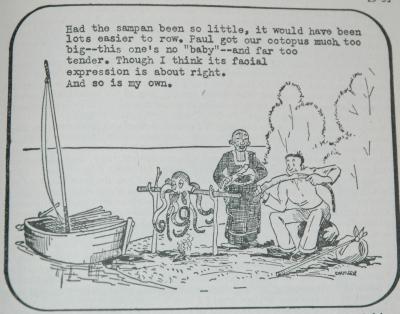 Patric was an early Libertarian, and is vehemently anti-government, anti-tax and pro-trade (also, weirdly, anti-zipcode!). This allows him to like the Japanese common man, despite the war, which could be blamed on the government. He travels all over, calling himself a "rumpin". Apparently "rumpin" is to "ronin" as Sancho Panza is to Don Quixote (though my Japanese dictionary just has "runpen" meaning "hobo"). He pokes his nose in when a Nazi girl visits the Japanese widow of a famous German doctor. He climbs Mt Fuji and Mt Komogatake. He goes to Matsushima, and hires the oldest boatman to show him around, later enjoying together a fresh caught octopus grilled on a remote beach. He has a small love affair with a maid at an inn in Nikko (there are a number of line-drawings, several of topless beauties, many of Japanese advertisements).
Later, he takes a steamer to Korea, where there are some ugly moments when he interferes with some Japanese police who nearly kill a small boy caught riding under the train. Manchuria is equally a grim experience. His stint in Peking is amusing, though. He makes friends with his rickshaw driver, and also hangs out with some marines who have a cheap refectory with coffee and hamburgers. He returns to Japan with just $2, spends a night in jail being interrogated, or perhaps just having a philosophical conversation. He finally gets back to San Franciso with 25 cents in his pocket.
I enjoyed this book. I wonder what ever happened to Patric's home at Frying Pan Creek, where he was trying to live off the land, and start a sort of commune. An unusual man.
Ron Harris wrote:
After re-reading John Patric's "A Yankee Hobo in the Orient", I was moved to Google the author. One of the most interesting hits was your review of his book, in which you wondered who Patric was and whatever happened to Frying Pan Creek.
I'm interested by Patric because he lived his last years in the small town of Snohomish, Washington (1967 population 4100), where I spent my junior-high and high-school days.
I never met Patric. He was a reclusive man whom everyone shunned as a weirdo. I often saw him, though, a raggedy old man with a flowing white beard, hiking the several miles between Snohomish and the nearest large town, Everett (pop. about 40 000). He always carried a walking stick in one hand and a canvas bag slung over his shoulder. In the bag were copies of "The Free Press" (I may be wrong on the title), a self-published newspaper which he distributed around the county. I don't remember ever reading a copy, but it no doubt expressed the same libertarian politics he put into "Yankee Hobo."
John's brother Bill ran a hardware store on the edge of town. It was a crumbling mess of ancient wood, iron junk, and every imaginable kind of hardware. Weathered hand-painted signs like "US out of the UN" and "Save our Salmon" were nailed to the storefront. Bill was notoriously crotchety and hard to deal with; "That old son of a bitch" was the way most locals described him. I don't know the nature of his relationship with John, just that they got along with each other and shared the same politics.
John himself lived in a decaying two-story one-time mansion overgrown with brush and hidden by a curtain of trees. Some time in the late 1960s the place caught fire and the top floor was burnt off. After that the house seemed deserted. However some said John still lived in the remains. Others said he'd moved to a small place outside town. The firemen said the house was so crammed with junk and garbage that it was a wonder any of it survived.
I left Snohomish in 1968. Twenty-some years later I went back to visit. By that time I'd discovered "Yankee Hobo," which I hadn't known about before. Bill's hardware store was still extant, but out of business. It seemed to have collapsed of old age and rot. Someone told me Bill lived in a tiny apartment somewhere in town, very old and very nasty. The city librarian, who was probably of Bill's generation, said John had died a few years back and no one missed him. I told her how I'd liked "Yankee Hobo," and thought it would have been interesting to meet the writer. She made a horrified face and told me John had always been "mean" and "awful," but that age had made him even worse. She actually considered him dangerous, though to whom or to what I don't know.
So while I can't tell you what became of Frying Pan Creek, I can at least tell you what happened to John. I hope this information interest you without being much, much more than you wanted to know. My compliments on your reviews and best of luck in the future.
I replied:
Fascinating!
If this were a Disney story, of course you would have snooped his property, got caught in a hole in the front porch, and then found out that he had a heart of gold, learned a moral about life and saved his treasures from burglars.
As it was, perhaps he just got mad and unbearable.
Or not...I googled harder still, and found this strange stream-of-consciousness account of how local Snohomish cops beat him up and set his house on fire! It looks like it was written by Mark V Shaney, though.
Also somebody of the same name wrote for the National Geographic...
There is more of a story here, still!
Ron Harris replied: Thanks for your reply to my e-mail. I read the stream-of-consciousness piece and wondered if I'd ever met the writer; his age and time in Snohomish seems to correspond to mine. However I'm reluctant to befriend anyone who gets from a police beating in 1957 to an auto transmission in the late 1980s without a single period.
John Patric's "National Geographic" pieces were condensed versions of material he later put into "Why Japan Was Strong." I may have one or two. It only now occurs to me that the article would have pictures of his travels.
By strange coincidence, the day after I received your letter my mother sent me a copy of the Snohomish paper with a reminiscence about the latter-day John. The author was an elderly minister with whom John felt a connection because both liked poetry, music, and other intellectual subjects. The minister received many letters and phone calls from Patric. I learned these interesting facts:
John's mother was one of the two librarians at Snohomish's library during the 1930s. John was the valedictorian of his high school class. His younger brother Bill was valedictorian of his own class. Patric is listed in a national database of political candidates, since he was constantly running for various state and local offices. At least once he received a couple of hundred votes; mostly he got less than fifty. And finally, the minister said that while everyone thought John was insane, Patric went to court (on his own behalf) and proved he was not. That would be some story.
There was also a photo of Patric from the 60s.
A fascinating fellow...
I replied:
Thanks again, and two related tidbits: Patric in jail for electoral fraud (dismissed), and the pseudonym he used.
I add (much later):
On EBay I bought a copy of the National Geographic magazine for April 1936, which has Patric's "Friendly Journeys in Japan" with 29 illustrations. The article content seems similar to that in the book, though toned down. The pictures have many different attributions, so are probably all stock and do not depict Patric's actual adventures (he surely had no money for film, anyway). Also, there were no "about the author" blurbs back then, so the purchase is a little disappointing, from the viewpoint of learning more about Patric.
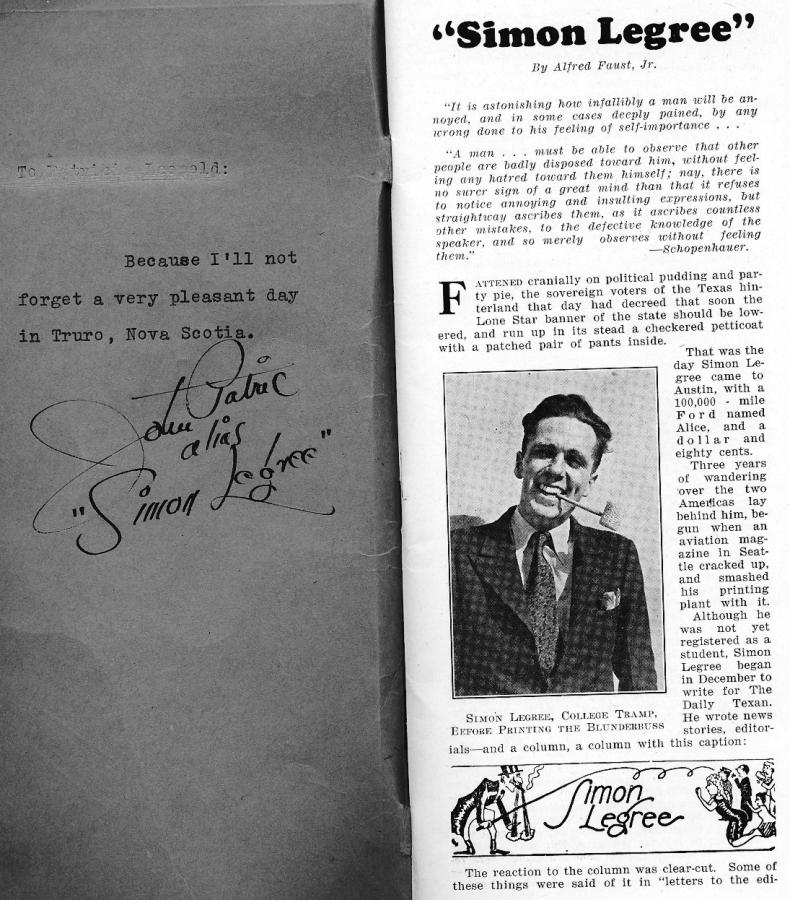
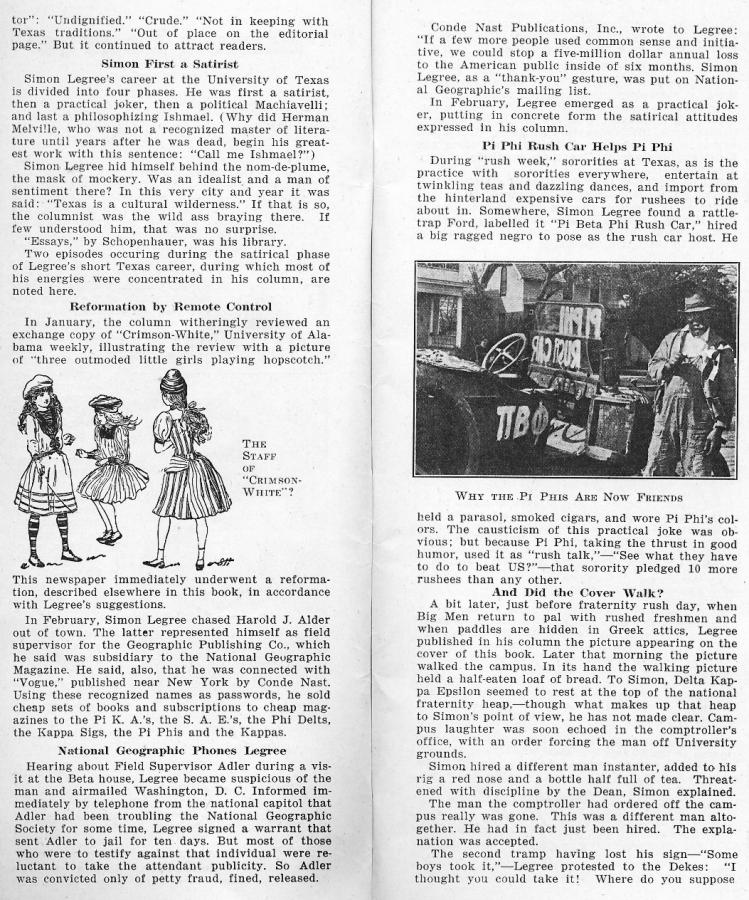
Sept 2009. In a fit of obsessive completism, I bought a pamphlet by Patric on EBay ("Simon LeGree's Book", dated May 1933). Among other things it tells the tale of how he published a school (University of Texas) newspaper, "The Blunderbuss", which made everyone angry at him. He was expelled, and seems to have been beaten up and maybe kidnapped as well. The rest of the pamphlet is filled with in-jokes and undergraduate humor. Patric already showed a fondness for tramps.
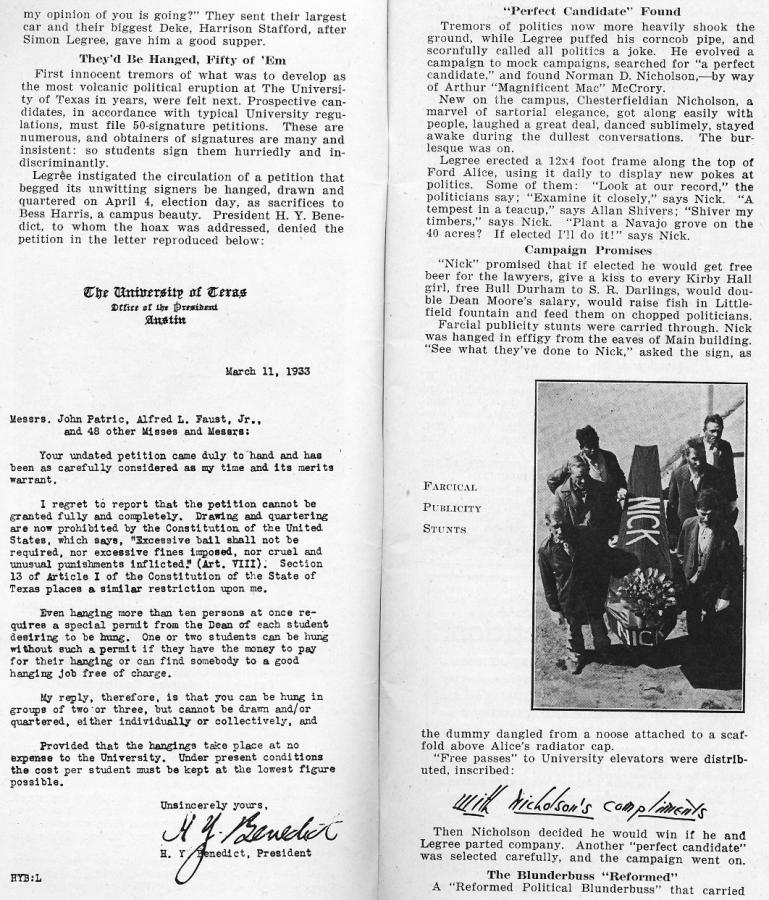
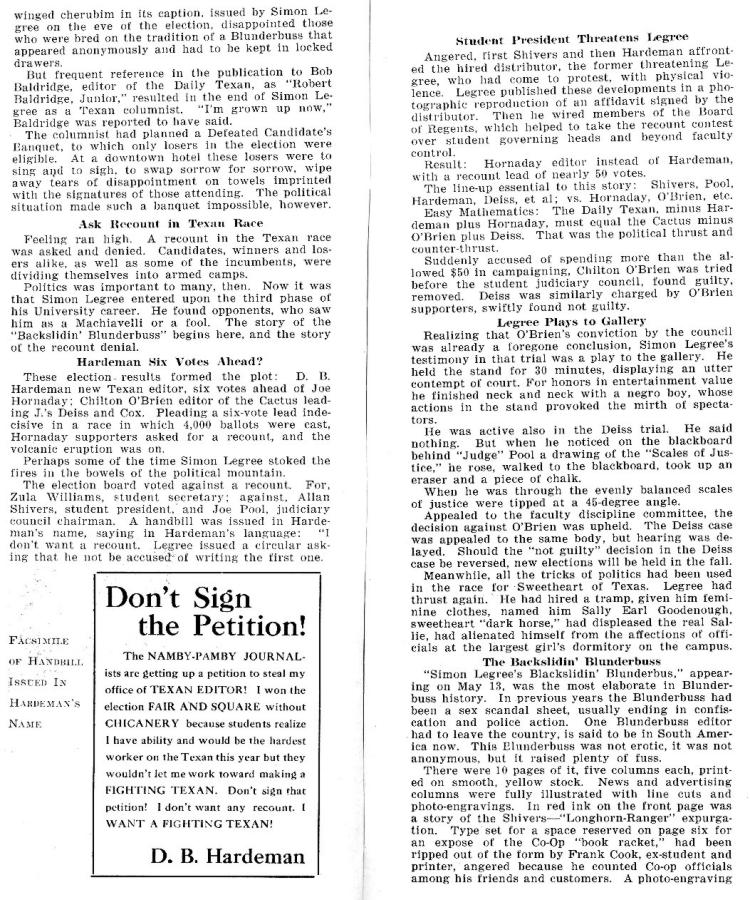
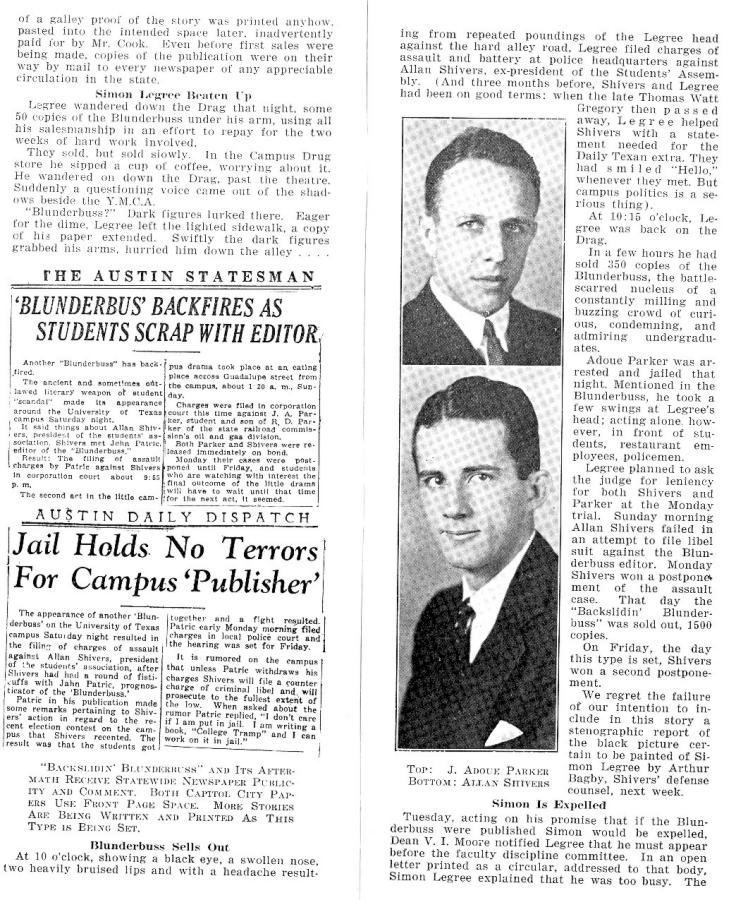
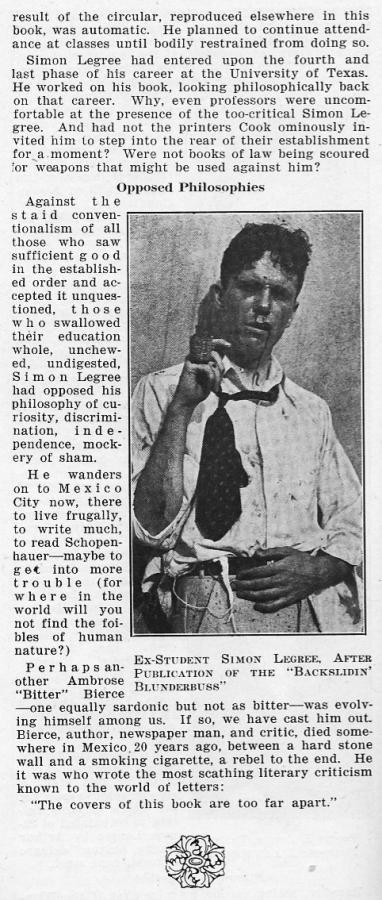
See also this blog.
Greg Beamer wrote in 2011:
It appears you wrote an article on John. He was indeed quite an individual. I was a young social worker who graduated from the University of Washington in 1974. I met John Patric toward the end of that year. I had taken a job as a houseparent working with juveniles east of Snohomish. I had each afternoon off, heard of John, and approached his living quarters one rainy afternoon to seek him out. John lived behind what was left of the burned-out family home. His mother, per my discussions with him, was the first librarian in Snohomish, and the library was actually in the parlor of the family residence. John's hatred of anything that had to do with government and advertisers began at a young age. He had been reading a magazine, and the ad said that if he sent in a request, they would send him a number of packages of "bluing" that was used in washing. All he had to do was to sell a certain number, and he would get a movie projector (that was shown in the ad). He fell for it, wrote for the bluing, received it, and then found that the same product could be bought locally for just a portion of the price he was get per packet. He finally wound up selling the majority of it to his mother, and sent off for his projector. When it arrived, it was a piece of junk, that quickly broke. His father told a group of his friends after school one afternoon when they were gathering around the family table for milk and cookies that they should considered themselves honored to know such a smart young man as his son John, and then proceeded to tell them how he had been duped. John was embarrassed beyond belief, and that started a festering hatred of advertisers that he would carry into his old age. I have no doubt it was one of the reasons he seized the opportunity years later by the Reader's Digest to travel the US exposing confidence men in the auto repair business.
John lived in with a great deal of paper, had a wood stove (amazing he and it never burnt to the ground), and when I first knocked on his door, he told me to get lost. I stood my ground, and told him that I was there to buy the Saturday Evening Free Press, which I understood was $5.20 a year, payable in advance. After a few moments, he opened the door -- he was quite a scary looking dude -- invited me in, and offered me a cup of coffee. I made the mistake of saying yes, and he took a thermos cup that was made of blue plastic, placed in some instant and some water, and put it directly on the stove to heat up -- I drank it out of respect and fear that I would be thrown out if I refused, so I sipped it and made small talk -- he then took my money, went over and went through some papers, and handed me a batch of back issues to take with me.
When I left I thought that would be the end of it, but Patric was a man of his word -- to my amazement a couple weeks later, a folded over 3 or 4 pages which were sealed across the top with one cent stamps appeared at my house. I became known, depending on his mind when he typed the address, The Very Reverend Beamer, or anything else that came to his mind. The reason he sealed his press with one cent stamps is because he hated the postmaster, and wanted to make his job more difficult. One stamp, one hit of the postmark. Multiple stamps, you had to work at it as every stamp had to be counter-stamped. The reason behind this stretch was two-fold. First, he hated that he had to pay full boat to mail his newspaper, but advertisers could mail vast amounts of mail and paid just a small pittance. His war on this was simple, he would take one junk mailer's information, put it in another junk mailer's envelope, and mail both back to each other with 1 cent stamps. This required the junk mailer to pay for the postage due, and when they opened it, they had someone else's junk. John's smile when he would tell me how he was just trying to help support the postal service with smirk right behind it!
He also had an in for the USPS, as he was ordered to cease and desist from putting the SEFP in the mailbox when it rained. The Everett Herald did it, so he couldn't see why he couldn't either. This wound up in US Superior Court -- the verdict was that neither he, nor the Everett Herald, could put the newspaper in there, as it was strictly for the US mail, properly stamped and paid for, or course. Have you ever wondered why all those posts with the mailboxes had a separate attachment to hold the local paper? Well, it was, according to John, in direct result to the findings of the US Superior Court -- it became a national issue.
While he was a character, he was clean, washed his clothes in one rain barrel, rinsed them in another, and hung things on trees near his house to dry. I had a 1957 Volkswagen, and he would hitch a ride in to see his editor and publisher in Everett -- He never smelled of anything but Ivory flakes. He did have a few other quirks, like always looking for a piece of wood to bring home -- his mother had driven that into him as a youth -- you always bring home some wood for the fire. Many times we would stop so he could go pick up a piece by the side of the road or from an alley.
I never met Bill, and quite frankly, don't remember him talking about him. I lost track of John when I left Snohomish. I still have original copies of the Saturday Evening Free Press, and if you are interested, I will send you some scanned copies if you are interested.
You allude to him being in court on insanity charges. Some of the city folk in Snohomish apparently thought it would be one way of getting him out of town -- simply have him declared insane, and throw away the keys. The only problem was that when he went to court, John acted as his own lawyer. His first and last question was for the judge to show him where it was stated that it was against the law to be insane, as long he did not hurt anyone or himself. Of course, there was no evidence of him doing anything wrong other than being a pain in the ass, and the case was dismissed. John might have been a thorn in their side, but he was not a fool. He told me once that he had actually debated at Cambridge and Oxford, and that he was friends with A. G. Bell, the editor of the National Geographic. He did indeed write articles in the 1930's -- thanks for validating his claim.
Thanks for taking the time to put something up on John Patric on the Internet. He was truly a one-of-a-kind guy, and I personally found him not only extremely intelligent, but quite dead-on in his opinions of those in government in Snohomish and Everett.
In 2014, Bill Betten, another Snohomish native, pointed me at his new website about Patric.
In 2021, however, the site no longer seems to be about Patric, if it ever was.
Shortly thereafter, David Lee Kendall also wrote me about Yankee Hobo, which is one of his favorite books. He pointed out that Patric's anecdote about being on a boat with an American missionary woman who got drunk and slept with a sailor was cruel because the expat community would immediately have known who she was. He recommended her side of the story, told in I Married a Korean (by Agnes Davis Kim).
In 2021, David Bromling helped me find the Everett Public Library online archive, which contains Patric's manuscript for Hobo Years among other things.